Interview in Mr. Online – Generational Differences in the Workplace
Our colleagues Judith van Haersma Buma and Job van Hooijdonk shared their insights in Mr. Online on generational differences in the legal workplace, the associated challenges and opportunities, and how organizations can leverage these differences to build more effective (legal) teams.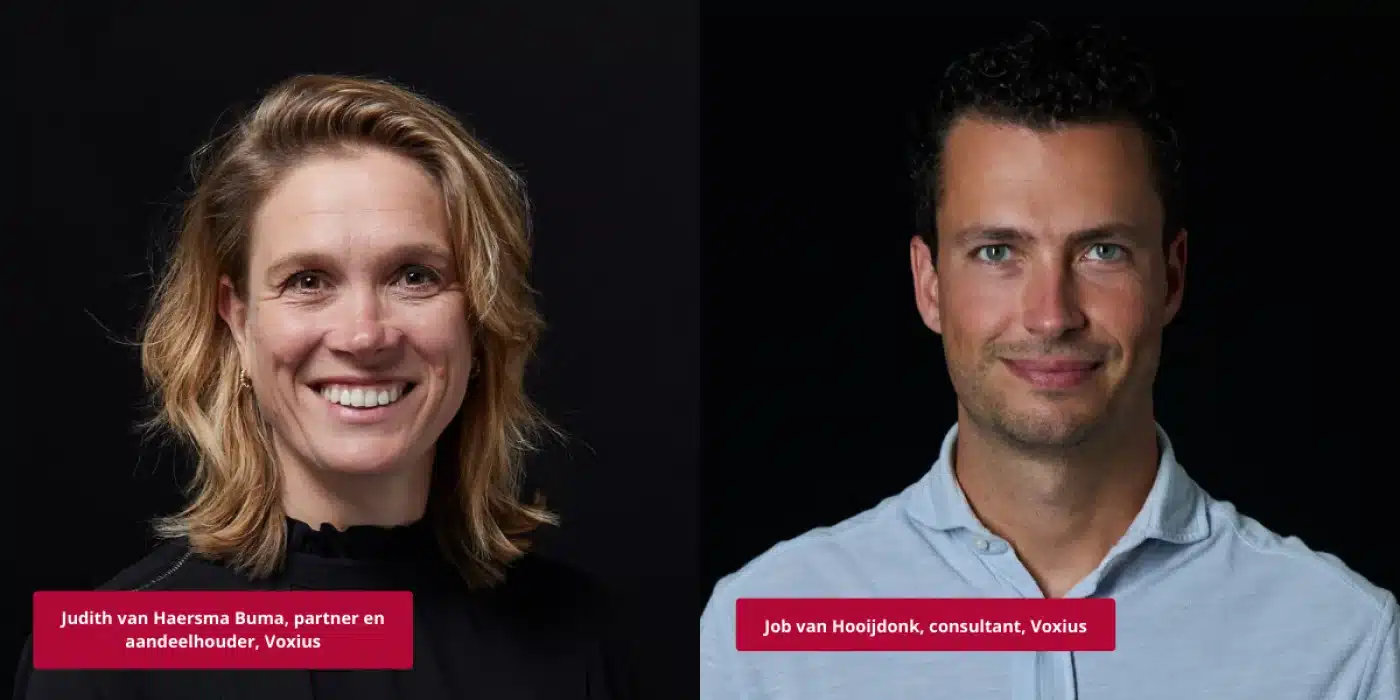
This interview with Judith van Haersma Buma and Job van Hooijdonk appeared in Mr. Online on February 10, 2026.
In their work at Voxius, an agency that specializes in placing experienced lawyers, Judith and Job interact with different generations on a daily basis. They don’t place entry-level candidates, but rather lawyers who typically have three to five years of work experience or more. “We often deal with employers who are part of the baby boomer or Gen X generation and are looking for a younger candidate,” Job explains. “You see that clients’ expectations and candidates’ needs can differ quite significantly. Younger lawyers seek flexibility, autonomy, and a healthy work-life balance, while older generations sometimes still cling to traditional views on work ethic and attendance.” In some cases, that gap causes friction.
Stereotypes Across Generations
Prejudices about generations are nothing new. Older employees are quick to label younger generations as lazy or spoiled, while young people sometimes view their older colleagues as set in their ways or lacking in innovation. According to Judith, however, that view is too simplistic. “Actually, every generation says the next one is lazy or spoiled,” she says. “But I don’t think that’s the whole story. Every generation simply wants to do things differently than the one before. The world is changing, and that naturally influences how you view work and how you work.”
That change is particularly evident in how people interact with technology. Older generations began their careers in a largely analog world, while Gen Z has grown up with digital tools. “For Gen Z, technology is the norm,” Job adds. “As a result, they work differently and also have different expectations of their employers—for example, in terms of resources, flexibility, and autonomy.”
From Five Days in the Office to Hybrid Work
A clear generational difference lies in the view of where and how people work. While working five days a week in the office was long the norm for older generations, hybrid work has become the norm for younger generations. Judith recalls a candidate who, ten years ago, expressed a desire to take one day off per week to do volunteer work. “At the time, the client considered that unthinkable. Nowadays, such a request is perfectly normal.”
The discussion about a possible return to a five-day workweek in the office recently caused quite a stir, especially among younger employees who have experienced the benefits of working from home. In practice, however, Job observes that very few organizations are actually returning to full in-person attendance. He believes that large, partially vacant office buildings are also a factor in this discussion, but he argues that this alone is not a good reason to bring people back to the office full-time.
Work as an identity versus work as part of your life
According to Job, a key generational difference lies in the role that work plays in a person’s life. “Older generations often see work as an essential part of who they are. Younger generations believe it’s important for work to fit into a happy life, rather than the other way around.” This also explains why younger generations are more likely to change jobs. Long-term loyalty to a single employer is seen as less of a given. Judith: “While young people are surprised by someone who has worked at the same place for 25 years, older generations, on the other hand, find it incomprehensible to keep changing jobs.”
The Value of Generational Diversity and Different Work Styles
Generational diversity can be a great strength, provided it is approached consciously and openly. In teams where differences are not acknowledged, frustration and misunderstandings can arise. But when generations learn to recognize and leverage each other’s strengths, synergy is created. “Seniors bring experience, a broad perspective, and risk awareness. Younger people often come up with fresh ideas and innovative solutions,” says Job. “That combination is incredibly valuable, especially in legal practice, where diligence and innovation must go hand in hand.”
Still, he observes that, in practice, people are often looking for someone just like themselves. “That’s simply what works best. It’s one of the reasons why diversity remains a challenge within many organizations.” At the same time, companies have no choice but to actively seek out younger candidates, even within the legal field. After all, to build a healthy team, you can’t hire exclusively from the same generation. Different generations bring different strengths and perspectives, and it’s precisely when those complement each other that a stronger whole emerges.
Technological developments also make generational differences even more apparent in the workplace. Younger lawyers often pick up new systems and digital tools more quickly, simply because they’ve grown up with them. At the same time, Judith emphasizes that many older lawyers are indeed interested in digitization and legal tech, although the pace at which they embrace these changes is sometimes slower. In the search for new candidates, technological affinity is playing an increasingly important role: today, jobs more often require “tech-savviness,” or at least a willingness to work with AI and new technology. This was hardly a criterion at all just a few years ago.
These differences are also exacerbated by changes in legal education. Young lawyers today are expected to bring not only a solid legal foundation but also digital skills and an affinity for technology. “A purely legal education is no longer always enough. Having something ‘extra’—for example, in the field of technology or data—is becoming increasingly important,” says Judith.
In this context, she cites the concept of “reverse mentoring” as an inspiring example: junior employees guiding senior employees in the areas of digital developments and AI. This not only promotes two-way knowledge sharing but also fosters mutual understanding and respect between generations.
The Role of Leadership
Effective leadership in a multigenerational team requires a tailored approach, Judith explains. Not every generation wants or is able to be managed in the same way. Younger generations often thrive under a more coaching-oriented leadership style, while older generations are more accustomed to a more directive or hierarchical approach. “Everyone wants to be heard in their own way, but how a baby boomer wants to be heard isn’t the same as how a Gen Xer or Gen Zer wants to be heard,” she explains. According to her, identifying, discussing, and accepting those differences is essential for the team to move forward.
For managers, this means they must be aware of the diverse expectations within their team and adapt their leadership style accordingly. This is also reflected in the topics that take center stage in conversations: for older generations, themes such as recognition, experience, and substance are often more prominent, while for Millennials and Gen Z, the conversation tends to revolve around development, emotions, and personal growth. Although these are, of course, generalizations, being aware of them helps leaders exercise leadership more effectively, both within legal teams and beyond.
Generational Differences as an Opportunity
For legal teams, this presents not only a challenge but, above all, an opportunity. By combining experience, loyalty, and professional expertise with digital skills, flexibility, and fresh perspectives, organizations can become more agile and innovative. “Don’t view generational differences as a problem, but as an asset,” Judith summarizes. “The strength lies in recognizing each other’s values, engaging in dialogue, and leveraging each other’s strengths.” Job agrees: “Every generation brings new core values with it. If organizations proactively respond to this and are willing to truly listen, they can not only strengthen their teams but also become more attractive to new talent.” The key? Understanding, communication, and a willingness to learn from one another.
Judith van Haersma Buma
Judith has been with Voxius since 2012 and became a partner/shareholder in 2022. She has a background in the legal profession and the business world. She worked for some time as a resource and development manager at a large British law firm. Thanks in part to her experience, she is able to provide optimal support to her clients in the business and legal sectors by facilitating the recruitment of (senior) legal professionals and advising on issues related to work allocation and the structuring of legal teams, talent management, and team evaluations.
Job van Hooijdonk
Job van Hooijdonk has been with Voxius since 2024. Previously, he worked as an M&A attorney at a British law firm and founded his own sustainable business. At Voxius, Job focuses, among other things, on executive search for permanent and interim positions in the business sector and on advising on partner recruitment processes in the legal profession.